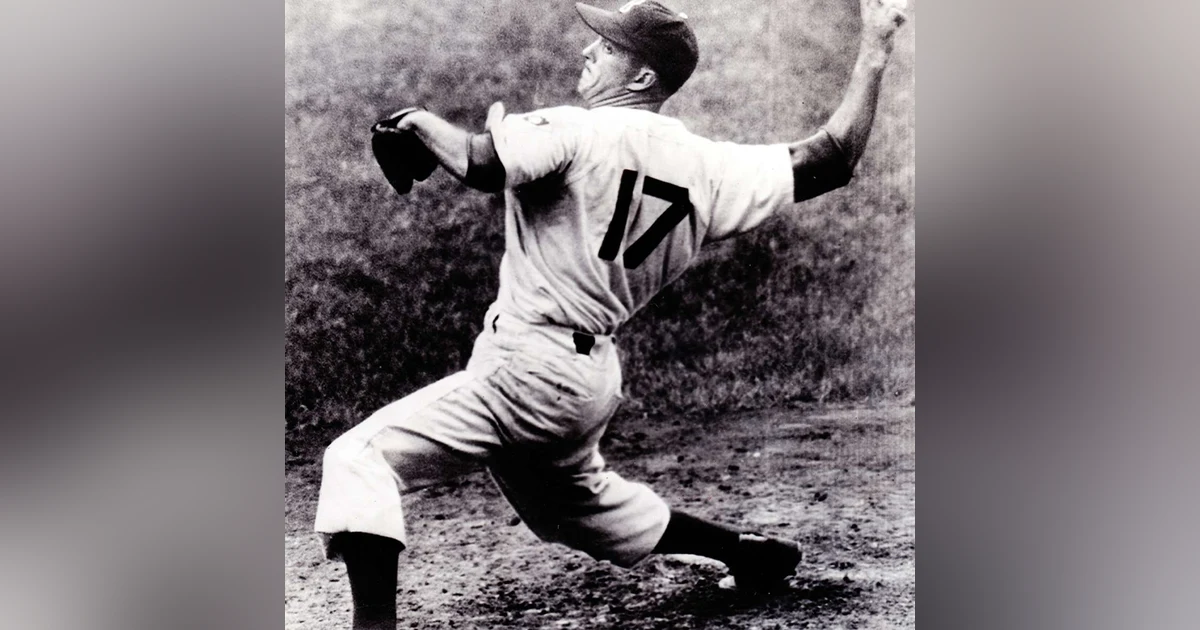
Brooklyn Dodger Legend Carl Erskine joins The Fellas (Summer Classic)


 Apple Podcasts

 Spotify

 Castro

 RSS Feed

 Youtube Music

 YouTube
As part of our summer classic series....get ready to step up to the plate with a true living legend, Carl Erskine, as he takes us back to baseball’s golden age. You'll feel the excitement of Ebbets Field and the thrill of being a Brooklyn Dodger as Carl shares his captivating stories. From his personal experiences with iconic figures like Jackie Robinson and Branch Rickey - to the intense rivalry between the Dodgers and the Yankees - to playing at a time when players and fans were neighbors who could share a ride to the ballpark - Carl covers it all. These tales are not just for baseball fans but for anyone who loves a good story.
Baseball historical enthusiasts will LOVE Carl's story about the "Shot heard round the world". No Wrong Choices will return after Labor Day.
This interview is provided courtesy of Sirius XM.
To discover more episodes or connect with us:
0:02 Hello and welcome to another summer classic edition of no Wrong Choices hosted by the FELLAS, where we are featuring classic interviews or some of our favorite interviews from our old Sirius XM show, the FELLAS. We'll be back with new episodes just after Labor Day. I'm Larry Samuels, soon to be joined by the other FELLAS, tushar Saxena and Larry Shea. If you enjoy these episodes, as well as no Wrong Choices, the, I guess, the traditional version, please be sure to follow us on your favorite podcasting platform and to give us a five-star rating. You can also connect with us and check out other episodes at NoWrongChoicescom or follow us on Facebook, instagram Threads and now X by searching for no Wrong Choices.
0:44 This episode features one of my favorite interviews of the entire time that we were doing the FELLAS, if not the favorite interview with Carl Erskine, former Brooklyn Dodger. Larry Shea and I had the opportunity to talk to Carl and you know I'll never forget. Before this interview started, I had a chance to very briefly set up the conversation with Carl and my earphones and he didn't sound like he wanted to be there. It was a very short, brief discussion and he sounded impatient. He asked how long we were going to be on the air for, and I really thought, going into this interview, we were going to have a problem.
1:28 Well, as it turns out, a half an hour later we blew off all the commercials and everything else, and what of having one of the greatest interviews that I've ever been a part of. Larry Shea, what were your thoughts on this? Yeah, I remember. Obviously reading the book, of course, you know, gives you a lot of insight into what you're about to get into. But I didn't know a lot about the Brooklyn Dodgers history, even living in Brooklyn, which I reference in this interview. But I had just watched HBO did a documentary called the Ghosts of Flatbush which is all about the Brooklyn Dodgers, so I just seen a lot of the history and a lot of the things that surrounded those teams that Carl was on and I just you never know how these conversations are going to go.
2:12 First of all, he's on the phone, right, so you don't know if he's going to get into it and be personable with it. And you know communication could sometimes be difficult. But I agree with you, Like, as soon as we started digging into the stories, I think it brought him back to the time and it allowed him to kind of, you know, flesh out what he was really feeling back in those days, which was pretty fascinating to uncover. So yeah, super enjoyable conversation here. And this is going to be one of those other instances where you're not going to hear a third voice on this. With that, that would be me, because often there would be instances where we wouldn't all three of us wouldn't be there available for an interview. So I had a chance to listen to this interview after the fact and I got to tell you you guys did a great job on it and Erskine is just a great storyteller.
2:57 He's just a great, great storyteller. And to be brought back to those days in the 40s and 50s of you know, when New York had three baseball teams the Giants, the Yankees and the Dodgers and just how, in so many ways, new York was like the center of the baseball universe and it didn't matter what else was going on in any other part of the country, because you knew, come fall, baseball was going to matter here in New York City. Yeah, and it's funny because I see where Ebbets Field stood, probably once a week on my drive to the golf course. I happened to drive right by it. And if you get a chance to come to Brooklyn, new York, go see where Ebbets Field stood, because it is an historic place.
3:43 It's not going to be much to look at, but there is an energy and a feel there. It's a parking lot and an apartment complex but there's a big mural across the street of all those great Brooklyn Dodgers Pee Wee, reese and Jackie Robinson and all those great guys. But it's a little slice of history that's no longer there and I think this interview gives a little bit of that magic to kind of hold onto it for a little bit longer, and that was really special for me. Absolutely, and, as you mentioned Jackie Robinson and Branch Rickey, these are the stories that we're about to hear, so, with no further ado, here is Carl Erskine. This interview is made available courtesy of Sirius XM. Also, I should point out that I am going by the name Alan Hale during this conversation, which is a funny story better saved for another moment in time.
4:33 We're caught in a trap. I can't walk out Because I love you too much, baby. Talking today's headlines, and then some, and now the fellas. Welcome back to the fellas, where I feel terrible about interrupting the music. I love this song. I'm going along with Larry Shea and our always inspired DJ Joe Pitts. I'm Alan Hale coming up in a little while. We're going to be speaking with Kevin James, star of the new movie. I now pronounce you, chuck and Larry, and also Howard Kamerick, author of the Curse of Carl Mays.
5:17 That will be in the nine o'clock hour, but before the East. I do that every week. Yes, you do. It'll be six West. That is correct, you out in California. For those of you somewhere in the middle, it'll be seven or maybe even eight o'clock, depending upon do the math. Don't ask me to do math. I'm a talk show host. Well, before we get to that, we have the honor and the privilege tonight to really speak to a legend. I think it's fair to say a legend. Carl Erskine, former pitcher for the Brooklyn Dodgers, is working, really just helping to promote a new book out called Through a Blue Lens, which is, I think it's fair to say, the story or really, in honor of Barney Stein, who was the team photographer for 20 years, did an incredible amount of work.
6:01 Carl's going to join us tonight to talk to us a little bit about Barney and what it was like to be a Brooklyn Dodger. Carl, how are you? Yes, thank you, I'm doing fine. I'm proud to be here. Well, thank you, you know. The first thing we wanted to ask you do you still live in Brooklyn after all these years? Oh no, Actually, I only lived in Brooklyn during the playing season. I was born and raised in a town called Anderson, indiana. We're northeast of Indianapolis about 30 miles. This is my hometown. I've always lived here. I came home in the off season, but Brooklyn was my home, usually from April till October and hopefully late October and hopefully yeah.
6:42 And it was for five beautiful seasons when we won the National League Championship and played in the World Series, all against the Yankees. In this course of history, we couldn't win one until 55, and then we did win one. That was a sweet victory. Yeah, that had to be the most amazing feeling. And just so you know, carl, I currently live in Brooklyn, so I understand exactly what that's all about. We were hoping to find a friend for Larry. Yeah, really good? Not at all. But you just touched on my first question, which is you know all those World Series you're going up against, you know the vaunted New York Yankees and the whole thing. And was there a sense of futility, year after year, when you would get to the doorstep and then just be so heartbroken when you didn't win those series?
7:28 Yeah, you'd have to know that team. The personalities of that team were strong. They were professionals. We were young guys together but Gell was pretty quick in the late 40s, early 50s and Jackie, of course, was our centerpiece and was our fire. He was the fire and the furnace because he kept us all fired up. That team never had an intimidating feeling playing anybody. Of course we played well in the National League and beat everybody regularly and the Yankees dominant and of course all the mystique of Yankee Stadium and all the history behind the great Yankee teams was present. There was no question about it. But we played those guys in the spring games, exhibition games, and there was no intimidation of playing the Yankees.
8:17 If there was any at all, it might have been in the 49 series when I was just in my second year and the whole team was pretty young and the Yankees. They pulled a dirty trick on us. Nobody ever admitted to it but they just changed the clubhouses in Yankee Stadium. The Yankee clubhouse for years was on the third base side and they remodeled in 49, 49. And they moved the Yankees to the first base clubhouse and then made the Visters the third base, the third base side, and when we walked into Yankee Stadium that's an awesome thing anyway, if you've never been there and the house that Ruth built and all that and all the things.
8:59 But we walked in the clubhouse for the Visters, which now is the old Yankee clubhouse. They had not moved two lockers. They'd left two lockers, including the uniforms, hanging. Oh, no, oh jeez. You know who the two were? Uh-oh. Who were? They, they were so good, of course, was that a dirty trick. That's a dirty trick Absolutely. And then they beat us four out of five games. And it's so funny because you're talking about ghosts there. I just want to mention very briefly that I had the pleasure last night of watching on HBO the Ghosts of Flatbush, when you were an absolute star in that particular documentary. I thought the stories that you told were unbelievable and it really helped me to understand those Brooklyn Dodgers teams.
9:43 And that's what my question is. I mean, how much of a family did you guys feel like, not just with each other but with the fans that supported you day in and day out? Yeah, you know, you have to go back and it's hard to do. The psychology of the times it was right after World War II Families were being reunited, baseball was being regenerated, teams were rebuilding, there was a great spirit in America. We fought on two fronts and all those service people had come home. And well, many of them didn't come home, but that was a new feeling, a beautiful feeling. Three teams in New York City that made that area pretty special and I think the gelling of that team, mr Ricky began to put together with 26 farm teams.
10:32 He had amassed almost 800 players under contract and of course I know 200 of them were pitchers. Fighting for your job. I'm telling you you look at all these hard throwing young guys that you say how can I ever get through this? But that was a competitive time and yet there was a good spirit and the team itself was, as I said, in the late 40s, was quite young. Pee-wee was one of the older players, had been there before the war, as had Ferillo, so they were kind of the beginning to build around. And then of course came Hodges was there and then Campy came in 48, duke came in 47 or 48.
11:18 I came up in 48, newcombe in 49, billy Cox was our slick feeling infielder and Jackie of course was the centerpiece with the history thing there which we didn't realize at the time. But it was a special time. But our team gelled in those early years and then began to win the National League, pan it almost every year and not grab that pressure in a series. And it was frustrating but it was one of those things in sports. We'd gone through the 51 season which you know. If you go back. We won a pin at 49. They'd also won it 47.
11:59 Jackie's first year I came in 48. And then we won in 49. We got beat on the last day in extra innings in 50. Then we got beat by the Bobby Thompson home run on the last day in the playoffs 51, right 51. Were they cheating, by the way, Carl? They were cheating, but you know you have to kind of qualify that there was no rule there was no baseball rule and there is not one to this day. That a rule against using any kind of paraphernalia to steal signs Pneuropsychoscopes, binoculars, the buzzer systems. There is no rule. They looked at trying to draft a rule. My understanding is a rules committee was going to draft a rule but it never happened and I don't think there's a rule today.
12:42 I mean, isn't it really like kind of part of the game? I mean you sit on one bench and you try to figure out the signs of the coach. You're always. It was always kind of understood. You know, if the catcher doesn't cover up well, or the pitchers Carol and gives away his pitches, those are all things you look for and it's legal. You know, on second base you try to figure out the system of the signs and then relay it to the hitter and that's all a part of the game. But nobody ever. Well, we used to say two places Wrigley Field, chicago, which had the scoreboard directly in center field, and the old days the big box where the numbers were dropped in was all done by hand. So there was a guy working back there behind and there was these openings.
13:24 We said you know, they're probably stealing our signs. In Wrigley Field and the polo grounds there was a clubhouse deep center field and a window was always kind of up six, eight inches and dark behind it. We said no suckers, I bet they're stealing our signs, but we never. We never called the umpire and said you know, can, would you check that out? We never did that, but there was always a little suspicion that maybe that was going on. But, as I said, branca has handled his role of being the pitcher who threw the pitch really well and I think he's got a new book that's been out to kind of exonerated him because Thompson said well, I could have taken a pitch, I could have taken a sign, but he never said he did.
14:06 But he never said he didn't either. Right, right. We're talking to Carl Erskine, who is helping to support a new book out called Through a Blue Lens, which is featuring and honoring the work of Barney Stein, the team photographer from 1937 to 1957. We're going to spend a fair amount of time talking about Barney in a couple of minutes but, carl, you know I have to ask the question. You know, of course, jackie Robinson. You played with one of the legends of all time in any sport and really in any walk of life. Tell us what Jackie was like? Well, first of all, he was very intelligent, very polished. He was a college man at a time when there were very few college people in Major League Baseball players.
14:47 But he'd been a UCLA four letter man. There, actually, people saw him play at UCLA. Football was his best sport, not baseball. But he was a polished, educated, dignified person. But he had a fire in his belly. He was really militant, he really was. He'd been treated with discrimination in the Army even though he was a captain. I almost got court martial because he wouldn't go to the back of the bus on a military bus and all that. And so he had a hot spot. And, mr Rickey, he was such a genius at reading and understanding people and his players and I heard him comment that he didn't want a passive individual, a passive individual who could just, you know, kind of not speak up or not bristle at indignities.
15:40 He wanted somebody that was strong enough to whip everybody on the field. But as he told Jackie, you're strong enough to do that, but are you strong enough not to fight? And Jackie considered it and said he thought he was strong enough not to fight. And so here's a man with the ability to fight and the strength to fight and a reason to fight, and he never did fight. And that to me was the most remarkable thing to watch Jackie go through the indignities he went through. Baseball is a rough business. From the other bench, you know, they get on you big time. If you've got a funny nose or a funny walk or you've had a divorce or whatever, whatever they get on you about to get to you, it's all fair game.
16:21 Well, you can imagine Jackie. He really was a big target for that but he handled it. He never spilled on anybody, he took a swing, he did do what. Mr Ricky asked him to turn the other cheek, and that was remarkable to see him do that. And then he did that for a couple of years. Then Mr Ricky turned him loose and Jackie was pretty outspoken after that. Yeah, he let that fire in the belly burn a little bit. No questions he did right, absolutely. Let me ask you about internally with the team, because I know you know initially there were a couple of players on the team, not a lot, but Dixie Walker, I know, was pretty outspoken about not playing with Jackie initially, and then he did eventually come around and some other players. But do you remember a specific moment where you looked around or something specific and you said you know what Jackie is our teammate and everyone's accepted him and we're going to win together?
17:09 Yeah, it was kind of a non-event on the team when I got there. I got there in 48, after Jackie rookie year in 47. But he was still not able to go to the hotels with us in the leg and was still, you know, separate from us after the ballgame and we saw that happening. That didn't register to us because America was actually segregated. I grew up in Indiana and Indiana was segregated. I had a good buddy named Johnny Wilson who was a superstar in high school basketball and later played with a Goop Trotter. Johnny couldn't go to the Y and swim and learned to swim program. We were kids because then I had black memberships. That's the way America was. So here was Jackie in this experiment, as Mr Ricky called it, on a team with us.
17:55 But this guy could play and he was exciting to play with and to watch. He made the game come alive. It had energy when he was playing and so people around the league, the owners, used to tell. Mr Ricky, before he actually made the move to bring Jackie in, that it would hurt attendance, that people wouldn't go to see a black player on a white team. Just the opposite happened. We packed the ballparks all over the league and exhibition games, regular season, whatever. So Jackie brought really some energy to the game and he was popular. So the guys that spoke up early on and said we don't want to play with him, they were southern boys Dixie Walker, bobby Bragan, both from the deep south.
18:41 They had to go home and answer to their buddies. They said you mean you sleep at the same hotel with this guy, you shower with him, you do all that. They had to say no in the beginning but, as you pointed out, they came around pretty quickly after they got to know Jack and see that he really did belong in the major leagues. Talking to Carl Erskine, who, of course, is a Brooklyn Dodger legend and also is talking to us about a new book called Through a Blue Lens, which celebrates the work of Barney Stein. Now, carl, before we get into Barney Stein, which we're going to do in just a second, the one last question that I want to ask you about your time with the Brooklyn Dodgers, at least on the playing front. We spent a lot of time talking about Jackie Robinson and what he did for the game, but it seems like somebody who's not celebrated quite enough is Branch Rickey, and I'm kind of curious as a guy, as a man, was he a good guy?
19:32 Was he approachable? What was he like? Well, mr Rickey was a genius. I think everybody that played in the Rickey era and played under Mr Rickey as a general manager speaks to him as Mr Rickey. He was respected, he was tough, he was cheap, he didn't pay us much. You'd have a good year to go in to see Mr Rickey and you're ready to talk about a nice raise. And he'd give you this father figure feeling and he'd pat you on the shoulder and say well, son, you had a nice year. We decided to let you come back. Nice. That's very thoughtful, sir. But I respected him for the way he handled his players one-on-one.
20:14 We were all young guys in early 20s I was 21 when I got there. Most of the pitching staff was young but he'd one-on-one tell us, talk to us about how to handle pressure, how to. He knew we were young and we'd be in front of big crowds, pennant races and whatever, and he took a personal interest in his players and and he helped me immensely to just get confidence in myself. I knew I could throw the ball, I knew I could pitch. But, boy, you walk out in Yankee Stadium. There's 70,000 people there, that's more people living in my hometown. So, man you look around, you could be overwhelmed. So he was great at handling the people that played for him, the personnel people.
20:57 That's where he and Mr O'Malley were so different. Mr O'Malley didn't have much knowledge of the game or on the field or the personnel. He was the all of the business, tycoon, the smart thinker, the futuristic thinker. But Mr Rickey was more of the father figure and he kind of took you under his wing and he helps you with things besides baseball, but in doing that he helps you play better baseball. Right, it's so funny when you think about the differences between O'Malley and Rickey, because I know it was well documented as well in the Ghosts series that I saw on HBO and you talked a lot about that.
21:38 I want to bring you back to the 55 game too. The game seven Johnny Padres, I believe is on the mound, and since it is the Friday, the 13th, we have to talk about this a little bit, because you mentioned on that program that in the ninth inning, when it looked like you might possibly break through and win this thing, that there was superstition going on in that dugout and everyone was kind of holding their breath. Can you take us back to that moment a little bit? Well, I don't know that that team was, you know, tense about anything, except that it was, the pennant was on the line. This was a final game. I was actually in the bullpen that day. I wasn't on the bench. In fact, I was throwing alongside Branca in the ninth when Newcombe, who had been pitching with short rest.
22:24 All of us had been pitching with short rest. And when he got to the ninth inning and the score was 4-1, they had two a couple of guys on and Dresden decided to make a pitching change. He called the bullpen while I was throwing, alongside Ralph and Ralph had just pitched two days earlier and. But he was throwing well and I was throwing okay, but I was bouncing a curve ball once in a while and when the coach answered Dresden, who's throwing the best, he says they're both ready, but Erskine's bouncing his curve. Some Dresden must have said let me have Branca, because Ralph went in the game. So that was a close moment. I could have been the pitch player, who knows what would happen.
23:05 You would have got him out, you would have got him out, carl. You know people say, carl, you pitched 12 years of big leagues. What was your best pitch? I said I think it was a curve ball. I bounced in the bullpen. They kept me from going to the game they pulled around. But anyway, no, I think it was tense in the sense that we had battled down the stretch and the giants had caught us after a 13 and a half game lead, which is unheard of, I guess a good team. We didn't fold either. We played just 500 or a little better down the stretch. But with a big lead a normal stretch we would have had enough to cushion ourselves to win the pennant.
23:47 But the giants put on this huge rush at the end of the season and just couldn't lose and they caught us. So we knew the pressure was on, but I don't think it was intimidating. I think it was just the case that here's a bunch of pros that got to go to work. We had to go 14 innings on the last day of the season against Philly just to tie the Giants. They'd already posted the score. The Giants had beat Pittsburgh, I think, and if we don't win that game in Philly we lose the pennant right there. But Robinson made a fantastic play back a second on Willie Jones to save it in the bottom of the ninth. Then he had a home run to 14th to win it for us. And so we had man, we had to struggle just to win the pennant.
24:29 But so that game and the final analysis looked like we're gonna win it. We had a four to one lead, but I don't know. Destiny was riding along with the Giants. I think I thought they could have brought Cy Young into pitch, I think Thompson might have done it with the home run. I don't know. I think Mike would have done it best. We're talking to Carl Erskine in support of a new book called Through a Blue Lens. Of course, Carl, Brooklyn, Dodger's Legend Pardon me Dodger's Legend and Carl, I wanna get into the book now. Barney Stein, a guy who really had almost unprecedented access to any team out there he was the team photographer for 20 years Tell us about Barney, tell us about his work and what he was all about.
25:13 Yeah, barney's personality helped him. He was not a pusher, he was a kindhearted person, soft spoken. We all had the sense. You know or at least I did, and I think most of the guys did. There were people in that entourage of personnel, not just players. You got groundkeepers, you got ticket takers, ushers, special cops and photographers. These guys were sports writers. These guys were all doing a job, they were all working, not making a lot of money. I think we all related to that. Well, barney was just a soft spoken person who had a job to do and in his own manner, his own personality, he got to be very close with a lot of the players and of course, you gotta remember, this team stayed together for 10 years and so we kind of grew up together, our kids grew up together, and so Barney was sort of a part of that.
26:05 He'd go with us on picnics once in a while, off day activities, take some shots, come to our homes occasionally to shoot a special piece, and so he was kind of one of us. You know, we just kidded him a lot. He had a famous saying which he'd take a shot and he would always say Oonamas, oonamas, one more, one more. And so we always kid Barney that that was his kind of his trademark as Oonamas. So I think we just respected him that he was a good pro, he wasn't pushy, he had a good imagination about setting up a picture and he was with us so much that he got a lot of unique stuff.
26:45 I don't think other photographer, hermes Sharfman, was another photographer that was around a long time and died before Barney, but the two of them were both really class people and I think Barney was just. He was a part of the whole picture. I'm looking through the book, as we're even talking here on the phone, and I just wanna call out two pictures in particular that I found incredibly fascinating. And this first one I know you obviously weren't there because it was a little before your time, but there's a picture of Babe Ruth in a Brooklyn Dodgers uniform that he snapped in 1938, which I found fascinating. But the other one is of Marilyn Monroe in 1957.
27:26 Now I know it was a soccer game that she was attending. Did you happen to be in the ballpark that day in? 57? No, I was not. Shame on you. My wife had things for me to do that. No, I'm sure she did. Now I've seen the picture. Gussie Moran was around on my day. You guys don't know who that was. She was a tennis star that wore gold LeMay panties in one of the British tournaments and she set the world on fire. I bet she did. She was in spring training with us a few years. That would go over. Well, today even gold LeMay panties. We've been talking to Carl Erskine again. The name of the book that's out is Through a Blue Lens, celebrating the work of Barney Stone.
28:08 I just want to ask you before we let you go here the demolition of Ebbots. I know you were there for the very end of Ebbots Field and you did go to Los Angeles with the team, but tell me about that last day when they actually started to tear Ebbots Field down. Yeah, we were advised. I was in New York, had an assignment working in New York and they let us know when it was going to happen. So Campy came using a wheelchair and Ralph Branko was there and Tommy Holmes, who was an outfielder, sweet-hitter for the Dodgers for a few years. We were all there and they did a little ceremony thing. Finally, this big ball was painted like a baseball white and had red stitches painted around it.
28:53 They finally, after a ceremonial deal, swung that ball over to the Visscher's dugout and when they dropped that dude, I was taking eight millimeter movies of this event, some of it, and I've got some of that footage when they dropped that ball on the Visscher's dugout. As much as I hated that Visscher's dugout, most of the time. But when I saw that cave in with that big ball dropped through it, I excused myself and left. I just had a sick feeling about the old ballpark and what had gone on there in the history. It just didn't seem right to see that starting to crumble.
29:34 I didn't go back to the site oh I don't know how many years, but Phil Foster, who was a Brooklyn comedian, I went back one time. We did a stand-up piece for one of the TV stations in New York in front of the 30-story apartment building that still stands where Evansville was. I was back to the neighborhood but that was a sorrowful finish for me to see it feel start to being demolished. Carl, how did the fans treat you guys? I know that they looked upon Mr O'Malley as a trader. Did any of that trickle over to the players? No, not at all. Good.
30:14 What the fans did. These were honest fans. If you had a bad day, they did not like it and they told you so in a lot of different ways, but when you had a good day, I'm telling you, there was nobody in the world stronger for you Out in the neighborhoods. If you were a Dodger, they didn't want you to pay rent, they didn't want you to buy groceries. They said, look, you guys are the team man, you're the Brooklyn Dodger. I'd go home after a. I lived on Lafayette Walk at Bay Ridge and five-pitch a shutout or a no hit or something. Go home. They have a street party. That's amazing. They put balloons on the trees and they did the whole thing. And babysitters and neighbors who we go on a road trip.
31:00 I never thought worried about my young little wife with two tiny little boys. I never worried about them in Brooklyn because the neighbors on Lafayette Walk, they were just like my hometown. Amazing. They were just there for us. So it was not such a shock culturally for me to go from a small Indiana town and my wife Betty to Brooklyn, because we found that the neighborhoods were like small hometowns. You got to know the barber, you knew the deli guy, you knew the butcher and the whole thing, and so it was not such a cultural shock. And then we went back. You know I played there 10 seasons so we went back to the same neighborhoods year after year and I still hear from our babysitters their grandma, their grandmother.
31:47 Wow, that's amazing. That's great, carl. This has just been an absolutely incredible story that you told to us Again the name of the book Through a Blue Lens Celebrate in the Work of Barney Stein. Pick this thing up. You know, larry and I have had it and we've had a chance to leave through all the photographs, and the full word, or one of the full words, in the front of the book was written by Carl Erskine. Yeah, and also please check out the Ghost of Flablish 2 on HBO, because it's a phenomenal, phenomenal two hours. Starring Carl, erskine Starring Carl. Erskine. And not by it Look fantastic by the way, Carl. Now there's just a few of us left, so I get to the stage now and we don't have too many of our old buddies. 11 of us left on the 55 team so great stuff though.
32:29 Carl. Really, we appreciate you joining us even for a few minutes. Thank you I appreciate the chance to speak with you and all the fans that still remember us. Definitely, Carl. Take care. Thank you again so much Bye-bye. So that was our conversation with Carl Erskine, which I hope lived up to the expectations that I set beforehand. I should point out that Carl, he's still with us, he's 96, and he just was awarded with a Lifetime Achievement Award in Cooperstown this past summer, 2023. And also he's been married to his wife for 76 years, so he has lived quite the life, god bless him.
33:09 Yeah, it's incredible. God bless him. I gotta tell you the interview, for one thing baseball stuff aside from the interview it transported me back to a time, obviously, when I was not alive, but to a point where I think I wish I would have been able to see what baseball was like when it was I don't want to say pure, but maybe a slightly more fun where, as you guys said in the interview, where the fans were far more involved in the lives of the baseball players. Right, erskine talks about living in the same neighborhood for 10 years in Brooklyn. He knew the barber, he knew the baker, he knew the butcher. You know he didn't worry about going out on the road because the neighborhood who watches wife and kids?
33:52 That's kind of that innocence in baseball that's been lost in the modern day sporting world and that's the kind of stories that I love, love, love to hear. I that's the part of the interview that really struck home with me. Yeah, no doubt there's so much to take from this the sign stealing stuff, you know, oh, the Yankees were cheating. You know like I love that kind of stuff. Obviously the Jackie Robinson stories are amazing and just talking about him as a teammate and what he was like as a person I think it's fascinating. But I always go back in this interview to the moment when he's in the bullpen pitching alongside Branca, you know, and how history could have been changed had he not bounced a curveball or two in that bullpen.
34:35 And the bullpen coach says, yeah, go with Branca. And the Bobby Thompson Branca moment happens. And how would things have been differently had he not bounced a curveball or two. You know there's a great movie about, about backup singers and it's three feet to history or something I wish I had the reference. But more importantly, just how history can change and how close we are to changing history based on these little moments of him bouncing a curveball for instance so fascinating stuff. Loved this conversation. Yeah, and I think for me it's so difficult to to to narrow down. You know the all that we heard, but one of the things that that that I reflected upon afterwards was the, the role of Barney Stein.
35:24 You know, pivoting away from Carl for a moment, the photographer that the the book that he was promoting through a blue lens, telling the story of a guy who was the team photographer for 20 years, who had an inside look at their lives and all the different things that were going on, and I imagine that photographer had to use a lot of discretion in terms of what photos made it out, what photos disappeared, what he saw. It's a very different world today where you know, with social media et cetera, et cetera, where everything is out there the very moment you do it. Well, back then the relationship with the press and with the media and with the photographer was, was incredibly different and it just it felt kind of good to hear all that of of sort of a simpler time.
36:12 So, carl, if you hear this, thank you so much for taking us back to a very special time in both baseball history and American history. Thank you again to SiriusXM for allowing us to share that with you. As I mentioned off the top, we'll be sharing other interviews from our old show, the Fellows, over the next few weeks as we get ready for season three of no Wrong Choices. We'll launch that just after Labor Day. In the interim, we hope you'll explore some older episodes of no Wrong Choices that you may have missed along the way and encourage you to subscribe or follow us on your podcasting platform of choice and on Facebook, instagram threads and now X, by searching for no Wrong Choices. On behalf of Tushar Saxena and Larry Shea, I'm Larry Samuels.
36:55 Thank you again for joining us and remember there are no wrong choices on the road to success. We learn from every experience.