There’s a Coach for Spelling Bees?
Yes. And having the right one can make quite a difference.
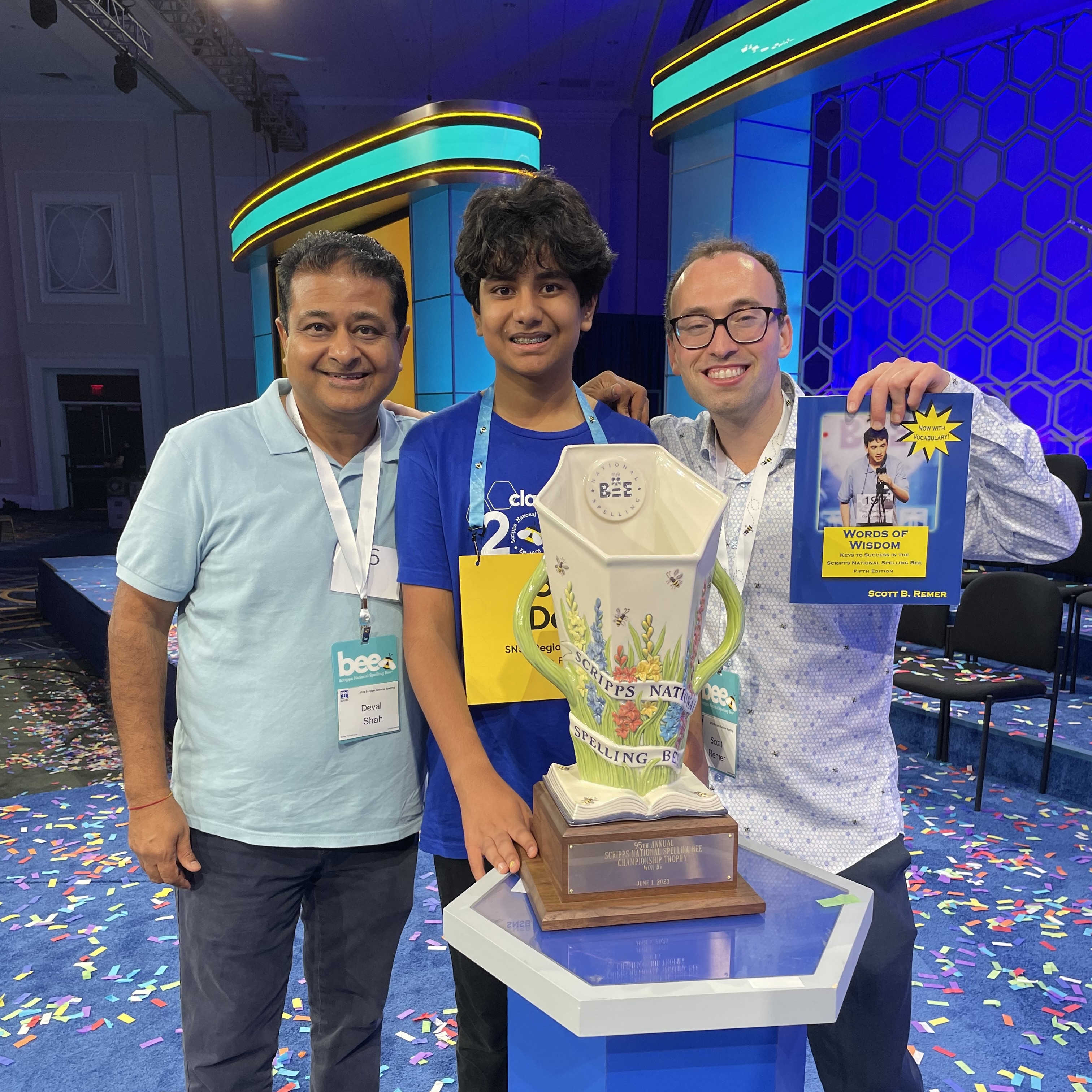
Scott Remer has coached five Scripps National Spelling Bee champions, turning a childhood fascination with words into a career that most of us probably didn’t know existed.
But Scott didn’t set out to become a professional spelling bee coach. In fact, his path to coaching some of the best young spellers in the country began with something he didn’t accomplish himself.
Scott was a serious competitive speller as a kid. He made it to the Scripps National Spelling Bee twice and finished fourth in his final year of eligibility. Like most competitors who get that close, he could tell you exactly which word ended his run. In fact, he can still spell it (now).
Rather than leaving the spelling bee world behind, Scott decided he had unfinished business.
At 14, he began writing what would become Words of Wisdom, a textbook designed to help competitive spellers understand the languages, roots and patterns behind the words they encounter. By 16, he had published it. Around the same time, he began helping other young spellers prepare for competition. One of his earliest students went on to win the National Spelling Bee.
A career Scott never could have planned was beginning to take shape.
More Than Memorization
Spend a few minutes talking with Scott and one misconception about competitive spelling disappears quickly: these kids aren’t simply memorizing enormous lists of words.
They’re learning how language works.
Scott teaches his students Latin and Greek roots, vocabulary, and the spelling rules associated with languages ranging from French and Spanish to German and Italian. When a student encounters an unfamiliar word onstage, the goal isn’t necessarily to have seen it before. It’s to gather information, recognize patterns and reason their way toward the spelling.
That’s part of what makes Scott’s work so interesting. He’s not simply teaching kids how to spell. He’s teaching them how to think when they don’t know the answer.
And the stakes can feel very real.
The most serious competitors can spend hours a day preparing. Then they have to walk onto a stage, stand beneath bright lights and cameras, listen carefully to a word they may never have heard before, and calmly work through the problem.
Scott knows that feeling because he’s been there himself.
Today, he encourages his students to compete as often as possible, in part because repeated exposure helps them learn to manage the nerves and pressure that come with competition.
When the Side Hustle Becomes the Career
For years, coaching wasn’t Scott’s intended career.
He attended Yale, earned a master’s degree at Cambridge and went on to work at the Council on Foreign Relations before taking a communications position at a synagogue in New York City.
All the while, he kept coaching.
Eventually, that “side” of his professional life was consuming another 15 to 20 hours every week on top of his full-time job. Then the pandemic arrived.
Scott returned home to Cleveland and began questioning why he was working so much instead of concentrating on something he genuinely enjoyed. In 2020, despite the enormous uncertainty surrounding both the world and the future of the National Spelling Bee itself, he decided to make coaching his full-time career.
It was a leap without any guarantee that there would be a landing, but Scott made it work.
He has now coached five National Spelling Bee champions and built a career around a skill and passion that began when he volunteered for a classroom spelling bee in fourth grade.
The Championship He Didn’t Win
Perhaps the most interesting part of Scott’s story is what he thinks might have happened if he’d actually won the National Spelling Bee himself.
He believes he might have simply moved on.
Winning could have provided a satisfying ending. Instead, finishing fourth left him feeling that there was more to do. That unfinished business led to a book. The book and his knowledge led to coaching. Coaching led to champions. And eventually, what began as a childhood passion became his profession.
Scott acknowledged during our conversation that, in retrospect, there were unexpected benefits to that failure.
That’s a lesson that extends well beyond spelling bees.
We’re conditioned to think of our careers as the product of the things that go right: the school we get into, the job we land, the promotion we earn or the competition we win.
But sometimes the more consequential moments are the ones that don’t work out the way we wanted. They leave us with something unfinished.
And occasionally, figuring out what to do with that unfinished business is where the most interesting career journeys begin.

Hello! I’m Larry, the first voice you’ll hear on No Wrong Choices, a podcast exploring the many paths to success. Having navigated the crossroads of media, business, and technology, I’ve learned that success isn’t a straight line — it’s a winding road shaped by choices, experiences, and unexpected turns.
From leading and scaling companies to mentoring the next generation of innovators, I’ve worn many hats — business executive, advertising innovator, professor, and devoted parent. My journey in broadcasting began at SiriusXM, where I spent years co-hosting the original Sirius Sports talk show Da Fellas — an experience that wasn’t just about sports, but about conversations, storytelling, and building lifelong friendships.
I bring a business-minded perspective and genuine curiosity to every episode, uncovering what drives artists, entrepreneurs, and athletes to embrace change, overcome challenges, and find their own way forward. Off the mic, I live in New York City with my family — cheering for the Yankees, Buffalo Bills, and Buffalo Sabres, listening to Bruce Springsteen, and staying active in the gym or on the court.
How Did I Get Here?


